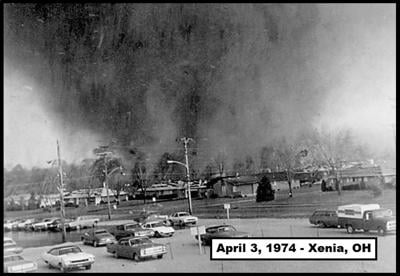
It was dubbed the “Outbreak of the Century”. The 1974 Super Outbreak, at that time, was the most violent tornado outbreak ever recorded with nearly 30 tornadoes rated to be at least an F4 or F5. On the old Fujita scale developed in 1971 by T. Theodore Fujita at the University of Chicago, this gave these twisters a ruinous rating of at least 207 mph winds. At this rating, research shows us that even well-constructed houses can be leveled, structures with weak foundations will be blown away some distance, cars will be thrown, and large missiles generated.
In total, 148 tornadoes swept across 13 states thrashing and terrorizing communities in roughly a 24-hour period from April 3 to April 4. The entire outbreak elicited a price tag of more than $600 million in damage just in the United States alone affecting the states of Mississippi, Alabama, Tennessee, Kentucky, Illinois, Indiana, Ohio, Michigan, Georgia, Virginia, West Virginia, North Carolina, and New York.
In Ohio, tornadoes killed over 40 people, injuring 2,000, and damaging nearly 7,000 homes. Most notably, the town of Xenia (Greene County), was the hardest hit where one of the most horrific tornadoes of the outbreak rolled in shortly after 4:30 PM leaving 30 dead and heading straight for Plattsburg and then on towards Clark, Madison, and Franklin Counties. It initially formed near Bellbrook, Ohio beginning as a moderate-sized tornado, then intensifying while moving northeast at 50 mph.
It was reported that students inside Xenia High School were practicing for a play, and took cover in the main hallway within minutes of the storm hitting the school and dropping a school bus right onto the stage. Areas outside Cincinnati were also affected with twin funnels reported, 4 deaths, 2 in mobile homes, and more devastation to area schools, churches, and medical centers. Furthermore, weaker tornadoes ripped through other northwestern Ohio counties of Putnam, Paulding, Brown, and Adams.
An eyewitness account from Allan Fisher, then a meteorological intern at the National Weather Service office in Columbus, Ohio, remembers “there were so many warnings and radar reports on the circuit, that you literally had to be very quick to start your tape to put it into RAWARC. The only time to enter your tape was when there was a break in circuit traffic, and that day there was virtually no break in the warnings and radar report on the circuit.” Fisher also mentioned that he received several reports that the storm tops were so high that they weren’t able to be recorded on the RHI scope.
Fisher says, “I remember being told the story of a call made to one of the county sheriff’s office looking for damage reports…the sheriff’s office was in the basement of a very old stone county courthouse built around 1900. The storm produced a funnel cloud which barely stayed aloft. It hit the top of the courthouse and totally striped out the clock. All they had on top of the courthouse was a steel box left with nothing in it.”
The 1974 Super Outbreak has since been passed by the 2011 Super Outbreak which lasted from April 25-28 and killed 335 people and injured over a staggering 6,000. More than 15,000 homes, businesses, and farm buildings were heavily destroyed and another 17,000 damaged.
Many consider this event a lesson learned for atmospheric scientists that better radar was needed, an expanded NOAA radio system, a better formulated safety system for schools, better warning lead time, and more warning sirens.



