
LIMA, Ohio (WLIO) - The use of artificial intelligence has become more and more widespread in the last few years - it seems like every thing from chatbots to even fast food drive-thrus are using some form of AI.
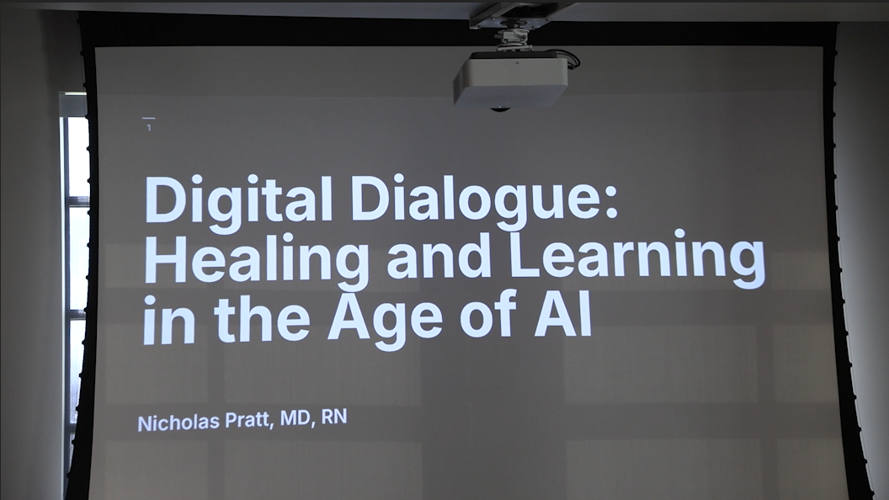
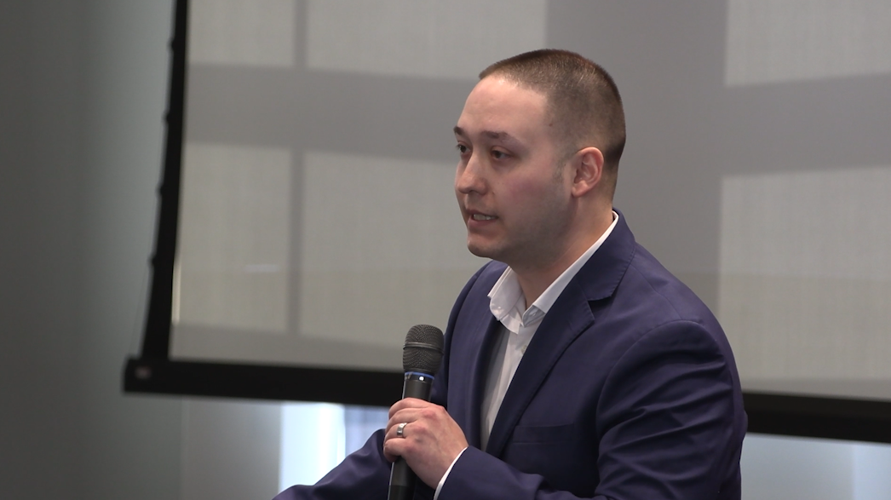
The healthcare industry is no exception, and that was the topic that Dr. Nick Pratt discussed with Rhodes State College with his presentation "Digital Dialogue: Healing and Learning in the Age of Artificial Intelligence". Dr. Pratt is a Rhodes State alumnus who is now a resident physician at the Yale School of Medicine, Department of Psychiatry.
He says that AI has been somewhat of a mainstay in healthcare for some time now.

The healthcare industry is no exception, and that was the topic that Dr. Nick Pratt discussed with Rhodes State College with his presentation "Digital Dialogue: Healing and Learning in the Age of Artificial Intelligence".
"AI has been around for a long time, and it's been in healthcare for a long time," said Dr. Pratt. "Actually, the FDA has been approving AI-enabled devices since the mid 90s, so it's been around for a long time, but we keep hearing about it more and more, particularly with the rise of generative AI. I anticipate that there's really going to be a lot of evolution and revolution when it comes to the implementation and adaptation of artificial intelligence, when it comes to healthcare and education."
Dr. Pratt discussed the difference between predictive AI, which uses data to guess trends or outcomes, reactive AI, which responds to things happening in the moment,, and generative AI, which creates new content like text or images, as well as what kinds of applications those different kinds of AI could bring to health care and education.
He also touched on the notion that AI is not an end-all solution, but more of a tool to be used alongside human knowledge and capabilities.

Dr. Pratt touched on the notion that AI is not an end-all solution, but more of a tool to be used alongside human knowledge and capabilities.
"The first thing is to not necessarily be scared of AI, to be able to be aware of AI, to understand its benefits, but also its limitations," said Dr. Pratt. "There's real limitations that come with the models of AI that we have available now, and being mindful that we have to also rely on our own human intelligence. So beyond artificial intelligence, our human intelligence to be able to make decisions that are best for our patients and for one another."
Rhodes State College now offers an artificial intelligence and machine learning program. More information can be found on their website.
