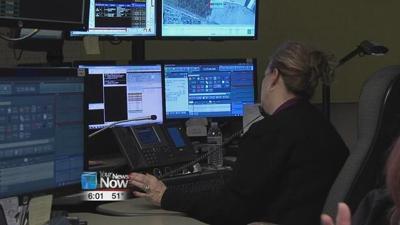
Before first responders put on their gear, load up their truck, and head out to a call, there's an unseen hero giving directions on the other end of the line.
"911, what's your emergency?"
"That's our lifeline, that's where the call comes in," said Allen County Sheriff Sam Crish.
A dispatcher is not just an operator, but a counselor, medic, and that connection to save a life. "We've heard that we're called first responders, and I think a lot of us wouldn't really see it that way," said Jessica Vorhees, a Communications Operator for the Lima Police Department.
365 days a year, in small dark rooms, they wait by the phone. "There's about 45,000 calls that we receive in our 911 center, roughly about 100 calls a day," said Sheriff Crish.
Dispatchers are taking those calls no one ever wants to receive. "We could deal with a medical emergency, you know have to give CPR instructions on 911, whether it's someone cut their hand or they're not breathing, you know it varies," said Vorhees.
Between tracking locations and addressing emergencies, a dispatcher's job never stops. "It is constant, it's truly 24/7, regardless of what shift," said Sheriff Crish.
But dispatcher's say a job that saves a life is well worth the stress. "Whether we're busy because the officers are doing something or the fire department's doing something, there's always something different to this job and I love that side of it," said Vorhees.
You can help dispatchers do their job by knowing where, what, when, and and who during your call. They ask that you only 911 for an emergency situation.



