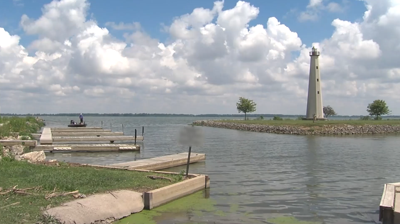
ST. MARYS, Ohio (WLIO) — New data shows toxin levels at Grand Lake St. Marys are trending lower than historical averages for this time of year, despite an early spring spike.
The Lake Improvement Association says the lake’s seasonal pattern appears to be running about two weeks ahead of normal this year, likely because algae levels did not drop as much over the winter. Officials say the current trend is encouraging, even though toxin levels remain above both World Health Organization and Ohio Department of Natural Resources advisory thresholds. Experts say years of conservation efforts around the watershed are slowly helping improve conditions.
“We’ve been looking at toxin levels for close to two decades now, and what we have been seeing is as a direct result of the conservation work being done around the watershed, and some of the lake improvement projects. We have seen the nutrients that feed the harmful algal bloom drop, and we have also seen the biomass of the algal bloom drop, and we have also seen the toxin levels of the harmful algal bloom drop. These are all great metrics, and they’re all indicators of success,” said Dr. Stephen Jacquemin, professor of biology and water quality at Wright State University Lake Campus.
Although levels have improved, people should avoid swallowing lake water while swimming or boating. Current toxin levels can be found at https://lakeimprovement.com/.