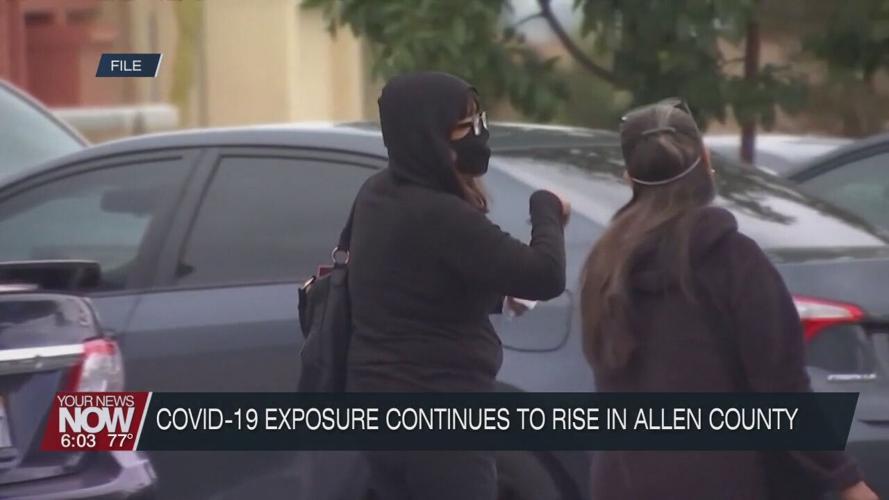

Allen County has now returned to a risk level 3 (Red) designation for COVID-19 by the Ohio Department of Health.

The county moves back to red after being in Orange Level 2 since August 13th, 2020.

According to the Allen County Health Department, the county has been experiencing very high coronavirus exposure and spread. The numbers have led to the county meeting 4 data indicators in the Ohio Public Health Advisory System as of October 22nd, 2020.
Those data indicators include new cases per capita, sustained increase in new cases, proportion of cases not in congregate settings, and sustained increase in outpatient visits due to COVID-19 symptoms.
In Allen County, cases per capita have reached 345.9 cases per 100,000 residents. The CDC considers a high-incidence case per capita at 100/100,000. Last week, Allen County's cases per capita was reported at 248.17/100,000.
A sustained increase in new cases have been reported at a 32.3 average on October 13th, after being set at 15.7 cases on October 1st.
An example of proportion of cases not in congregate settings are long term care facilities, indicating community spread.
Outpatient visits have more than doubled, being set at 30.9 as of October 20th, after being reported at 14.1 on October 4th.
The Allen County Health Department states that the majority of the cases are due to residents interacting in social settings, not from any one large event. In the month of October, there have been 651 newly reported cases of COVID-19, which is 25% higher than the number from August 2020, which was previously the highest incidence month.
A total of 38 counties in the state of Ohio have been designated at level red as of October 22nd.
A high per capita rate has been reported in Northwest Ohio, with four area counties listed in the top 5 highest per capita counties in Ohio.
The Allen County Health Department has released the following guidelines that residents are encouraged to follow:
Every decision regarding participation in an activity should be filtered through the following questions:
- Will all participants present be able to be 6 feet apart from one another?
- Will participants be wearing face coverings, unless actively eating or drinking?
- Will hand washing and sanitizing opportunities be readily available?
- Will cleaning and disinfecting be conducted regularly?
If these measures will not be in place, individuals should reconsider participating in that activity until the spread of COVID-19 subsided in Allen County.
Steps to take to slow the spread of COVID-19
Everyone:
- Protect others and yourself: Assess your health every day and stay home if sick
- Stay home if you are awaiting for COVID-19 test results, or if you are a close contact (within 6 feet for longer than 15 minutes) to someone diagnosed with COVID-19
- Maintain social distancing of at least 6 feet from non-household members
- Wear a face covering in public
- Follow good hygiene practices: Wash hands, use hand sanitizer, cover coughs and sneezes, avoid touching your face
- Decrease in-person interactions with others when possible, especially with anyone considered high risk
- Avoid traveling to high risk areas; and if you are high risk, consider necessary travel only
- High risk individuals/People who live with high risk individuals: Limit attending gatherings of any number/size
Social/Recreational Activities:
- Consider: Does it make sense to do this activity now when we are trying to reduce in-person interactions?
- Increase virtual interactions rather than in person gathering, e.g. church services, club meetings
Businesses:
- Ensure a minimum of 6 feet between people. If not possible, install barriers to reduce the risk of spread
- Refresh or change up your signage on health and safety guidelines in common areas
- Make visual cues for employee distancing more noticeable, e.g. X's on lunch room seats to promote distancing
- Promote measures to maximize social distancing, e.g. drive thru, pick-up and delivery services, outdoor dining
- Promote phone/on-line transactions
- Use virtual methods for meetings or cancel/postpone in-person meetings when unable to social distance
- Enforce facial coverings for employees
Retail/Services/Entertainment:
- Stagger entry of customers and guests
- Enforce face mask usage for employees and customers upon entry
- Increase availability for curb-side pick-up, if possible
- Establish and enforce maximum capacity
- Remind customers to observe floor markers for spacing, use alternate registers
- Update or rotate social distancing signs/reminders at your entrance
- Disinfect high-contact surfaces hourly
- Make regular announcements to remind customers to follow social distancing and personal hygiene measures
- Designate one-way aisles
Lowest Risk:
- Outdoor activities
- Space for people to spread out, 6 feet or more apart from each other
- Use of face coverings
- Fewer people
- Limited time in close contact to others
- Handwashing facilities and/or sanitizing products readily available
- Frequently touched surfaces cleaned and disinfected often
- Individually wrapped or served food
Highest Risk:
- Indoor activities
- Confined spaces
- Crowded conditions, people close together
- No or limited use of face coverings
- More people
- People spending long periods of time near each other
- Limited handwashing/sanitizing products
- Limited cleaning and disinfecting of surfaces
- Equipment/supplies used by multiple people
- Buffet/self-serve food



